AI website migration and replatforming
Large-site migrations with URL inventory, redirect mapping, metadata parity, analytics hooks, and post-launch Search Console checks.
ServiceWebsites, apps, and software built with AI—you own the code.
Short answer
48vproducts.com left its old WordPress store for the shared storefront in this monorepo (`apps/web` and `apps/cms`). Catalog, checkout, and fulfillment run in that stack today. The old host has 301-redirected to the new store since late October 2026, and sales held steady or grew after cutover. Post-cutover PageSpeed lab scores are 100 on desktop and 75 on mobile.
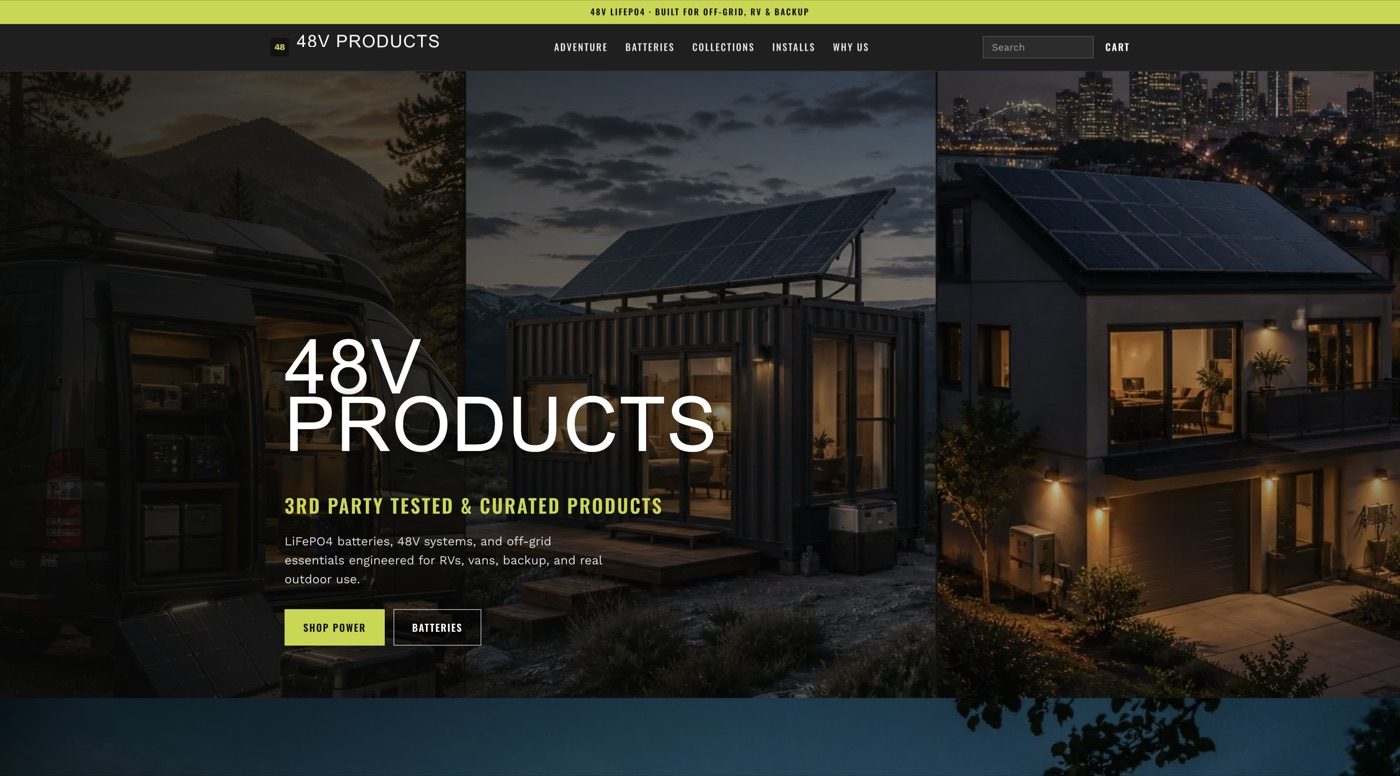
48vproducts.com sold sodium-ion and related power products on WordPress, hosted on a separate subdomain. Product copy, pricing, and merchandising lived in the WordPress admin; plugins and theme overrides carried years of incremental changes. That stack was acceptable for early sales, but inventory, structured data for Merchant Center, and a modern checkout path were harder to evolve safely inside WordPress alone.
The store moved into this monorepo:
apps/web — the customer-facing Next.js storefront (browse, cart, account, tracking pages).apps/cms — Payload CMS for pages and product content, wired to Medusa for cart, regions, Stripe payments, and fulfillment hooks.Editors manage catalog and editorial pages in CMS; commerce events (order placed, fulfillment created) flow through the same shared commerce platform as sibling storefronts in the monorepo. The work matches our website migration and legacy modernization playbooks: inventory URLs, redirect discipline, and parity checks before traffic switches—not a theme refresh on the old host.
An ecommerce cutover that loses checkout, tax, or feed integrity is a failed launch. This rebuild preserved:
Tracking and ads configuration were re-tested on staging; details mirror what we document on methodology—human sign-off before DNS, automated checks in CI where this repo provides them.
Revenue trend: after cutover, sales held steady or grew (internal figures only; we do not quote revenue or conversion rates on this page).
Live site: shoppers today use https://48vproducts.com/ on the monorepo stack described above.
Cutover: late October 2026. The old WordPress host now returns path-preserving 301 redirects to the new domain, with old /product/<slug>/ URLs mapped to /products/<slug>/ so links and search equity carry over.
PageSpeed lab scores after cutover (Lighthouse 12 performance category, home page, measured 2026-11-07): 100 on desktop and 75 on mobile. These are lab scores, not Core Web Vitals field data. Mobile Largest Contentful Paint is about 4.9 seconds on a throttled mobile profile, driven by hero imagery; desktop LCP is 0.8 seconds. Layout shift is zero on both.
No baseline: PageSpeed was not recorded on the WordPress host before cutover, so we do not claim a before-and-after delta.
Together with eight large healthcare WordPress rebuilds (case study), this store is the ninth production site PunkSolid cites as rebuilt off WordPress into code the client owns. The ecommerce path proves the same code ownership outcome as multi-thousand-page content sites—only the checkout and feed constraints differ.
Nobody recorded PageSpeed scores on the WordPress store before cutover, so we publish only post-cutover lab scores and say how we measured them. Mobile LCP is the open item: hero imagery loads in about 4.9 seconds on a throttled mobile profile, and image work is next on the store's backlog.
Yes. The public store is [48vproducts.com](https://48vproducts.com/). DNS and redirects moved traffic off the old WordPress host; product URLs and checkout were rebuilt in the monorepo rather than patched inside WordPress.
The storefront and CMS live in the client’s monorepo with full repository access at handoff—same model as our other migrations. See [code ownership](/services/code-ownership/) for how independence works after delivery.
Tell us what checkout, feeds, and fulfillment integrations must survive cutover—we map them before DNS moves.
Large-site migrations with URL inventory, redirect mapping, metadata parity, analytics hooks, and post-launch Search Console checks.
ServiceIncremental refactors and replatforms for revenue systems that cannot pause—scoped in Cursor with full code handoff.
ServiceEvery PunkSolid client receives full access to finished code—maintain it in Cursor, hand it to another developer, or stay independent if we part ways.
ServiceEight healthcare provider sites of 1,000–6,000 pages each, rebuilt in Cursor with their tracking stack. Mobile PageSpeed went from 65–75 to 92–98.
Case study